Introduction#
import veux
AISC#
The from_aisc function generates standard steel shapes using an AISC identifier.
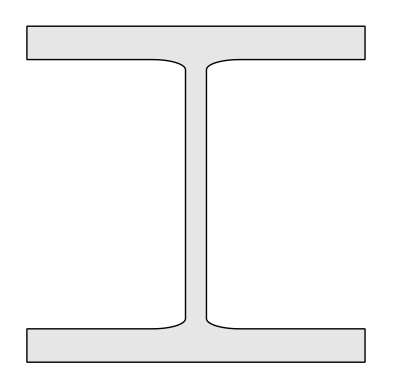
For example, the following code creates a WideFlange object with the dimensions of an AISC W14x211 shape.
from xsection.library import from_aisc

shape = from_aisc("W14x211", fillet=True)
veux.draw_shape(shape)
Properties#
Once a shape is constructed, elastic properties can be extracted from the elastic attribute:
print(shape.elastic.Iy)
2660.8931001437513
The summary() method can also be used to print all properties at once:
print(shape.elastic.summary())
  Iy : 2661
  Iz : 1027
   A : 62.26
   J : 46.94
 Iyz : -2.998e-13
Mesh Size#
The size of the mesh is controlled by the mesh_scale argument.
shape = from_aisc("W14x211", fillet=True, mesh_scale=1/2)
veux.render(shape.model)
Units#
By default, the from_aisc function builds shapes in standard english units.
This can be changed using the units argument.
Some options are:
Key |
Base units |
|---|---|
|
Meter-kilonewton-second |
|
Inch-kip-second |
|
Foot-kip-second |
shape = from_aisc("W14x211", fillet=True, units="mks")
print(shape.elastic.summary())
  Iy : 0.001108
  Iz : 0.0004275
   A : 0.04017
   J : 2.19e-05
 Iyz : -4.827e-20
Standard Shapes#
Rectangle#
from xsection.library import Rectangle

shape = Rectangle(b=12, d=18, mesh_scale=1/2)
veux.render(shape.model)